 Easter does not have a fixed date in the calendar. It is tied to the spring equinox. The starting day is Sunday, which is set as the first Sunday after the first full moon coming after the astronomical day of the vernal equinox (around March 20).
If the full moon is just on a Sunday, the following Sunday is taken as binding for the date of Easter.
Palm Sunday
On Palm Sunday, goat willow catkins were brought to the church for consecration and were widely used on various occasions throughout the year. In the north-western corner of the Kysuce Region, birch tops or red yew twigs were also used for this purpose and thought to have magical power. During a strong storm, a few of them were thrown into the furnace, and together with a lighted candle it was supposed to protect the house from lightning. They were put behind pictures on the walls in the house and on a horse carrier´s hat or on a horse-collar at the first spring ploughing. It is said that in the earlier times, Morena who ended up being burned in a stream, was used as a symbol of winter and old life. Having marched around the whole village, they stripped Morena of clothes, threw her into the water to drive away the winter with all diseases, death, and everything inhibiting the arrival of spring. Then they were walking around the yards and sang songs. As a reward, they received homemade gifts.

Marching with Morena in Čadca
Marching with Morena 2018 – author Pavol Piroha
Green Thursday
Arriving from the church on Maundy Thursday, one could feel a special atmosphere. The evening chores were done in silence, and it was like that until the Resurrection. People were deeply indulged in these moments as if someone in their close family had died. On Maundy Thursday, when the bells were tied, everyone went outside to wash with cold water. On this day, until the tying of the bells, the farmers liked to graft fruit trees. The night from Maundy Thursday to Good Friday was the night of treasure hunters.
Good Friday
On this day, there was no more work in the field. Church ceremonies were attended by those who could and managed to participate. Rainy weather on Good Friday was not a good sign, it meant a bad year to come. Young girls seeking a groom used to go to the forest on Good Friday and carry away whole pieces of anthills with ants. They tied them well so that the ants did not get out and put them under their pillows at night. In the morning, they let them out behind the house, careful of not being seen, saying t themselves: "Let the young men swarm around me, as these ants are swarming!"
White Saturday
The bells were untied on Holy Saturday. At the first bell, people ran to wash in the stream to get rid of all diseases. White Saturday was the day of the resurrection of Jesus. Even here, especially in the morning, cleansing habits prevailed.
Easter Monday
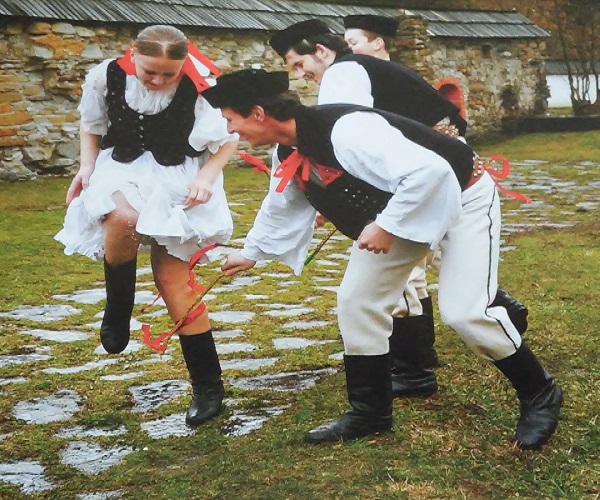
In most cases, Easter in Kysuce was still cold. However, the tradition of pouring girls with water remained untouched whether it was snowing, or sunny. Not a single woman escaped the water or a willow whip. If it had happened, many would not have forgotten about it throughout the whole year. Some of them ended up in the stream, others at the well, spraying fragrance was unknown yet.
The Easter table was decorated with a baked lamb, eggs that symbolized the birth of a new life, and there were goat willow catkins of Palm Sunday in the vases.
Easter tradition of whipping
Literature and photographs used from books: Traditional healing and folk magic in the upper Kysuce
(Author: Jozef Marec)
Kysuce
(Author: Jaroslav Velička)