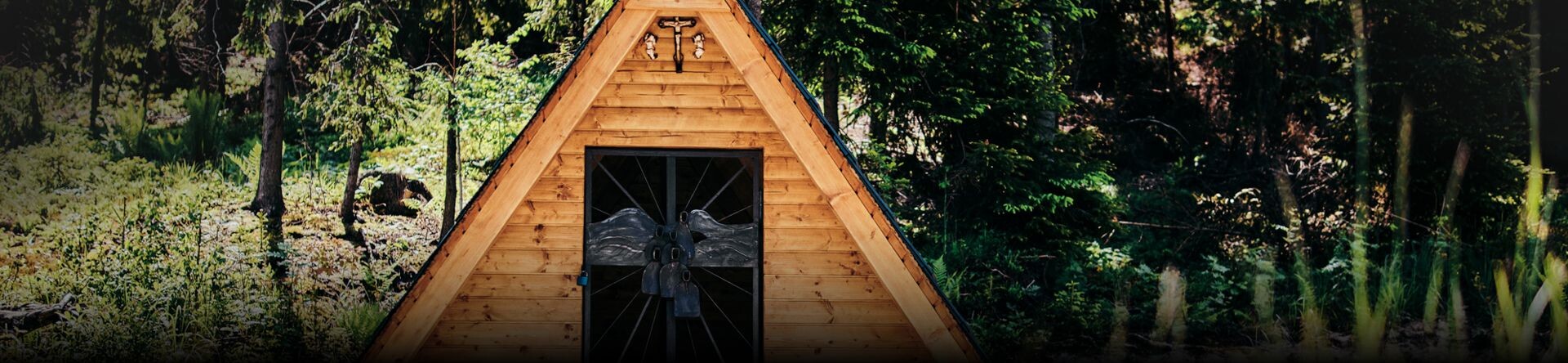
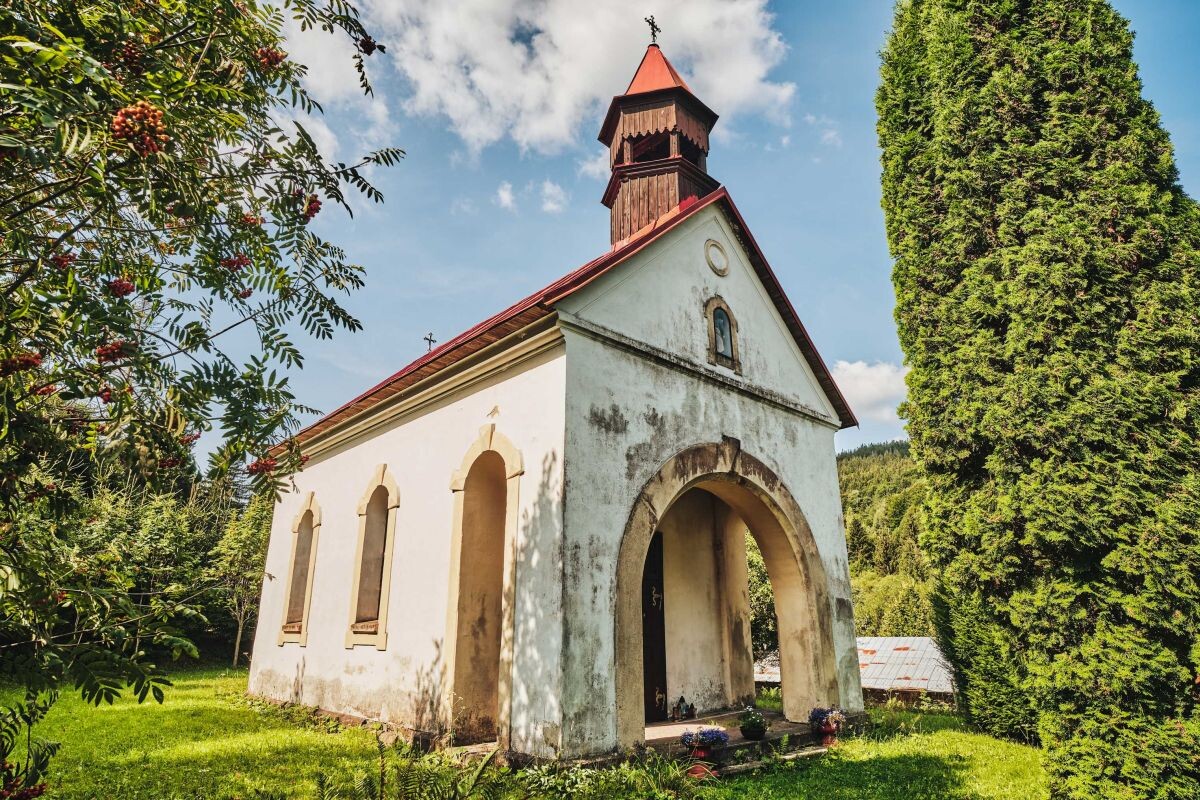
 Jozef Krutošík had the chapel built as a thank you for the healing of his wife. The chapel is located in the settlement of Jedľovník.
Date of construction: 1888 – 1893
Patronage: Our Lady of Lourdes
Location: Vysoká nad Kysucou, Jedľovník, GPS: 49.3580219N, 18.5178297E
Material: stone, wood
Altar/Sculpture: A single-nave building with a semicircular apse. Inside, there is a neo-Gothic wooden polychromed altar painted in gray, with some parts framed in light blue. In the central niche stands a statue of Our Lady of Lourdes in white robes with a golden trim and a blue belt, adorned with golden roses at her feet. From her right hand hang two rosaries (which are not original). Above the niche, in the upper part, is the monogram of Mary painted in gold. At the highest point of the altar is a small Latin cross with a four-leaf clover design in gold, with the transverse beam being ornately grooved. To the right of Mary on the altar (next to the niche) is a statue of St. Joseph holding the infant Jesus. Jesus holds a globe with a cross in his left hand and makes a blessing gesture with three raised fingers of his right hand. To the left of the altar niche is the statue of St. Veronica holding a white cloth with the imprint of Christ’s face (these two statues reflect certain symbolism referring to the founding couple of the chapel – Joseph and Veronica Krutošíková). In the center of the altar mensa is a small tabernacle, the front of which – the doors are light blue and decorated with motifs of a chalice, host, vine, and ears of grain, which are polychromed. On the tabernacle is a smaller wooden cross with a white corpus of the Crucified. On both sides of the tabernacle stands a pair of simple brass candlesticks. In front of the tabernacle is a portable altar stone embedded in the mensa, upon which stands a smaller brass cross (possibly for offertory?). On the edges of the mensa are two smaller brass candlesticks, decorated with three blossomed natural lily flowers. The altar mensa, like the entire altar, is gray in color, decorated with polychromy, and has light blue framing at the bottom. Hanging in front of the altar from the ceiling, on a rope decorated with four gilded spheres, is a brass lamp – eternal light. To the left of the altar is a smaller wooden cabinet (probably original) for storing liturgical vestments and equipment.
Date of consecration: 1895 (On August 28, the bishop granted permission for the chapel's consecration)
Founder: Jozef Krutošík
Consecrator: Ignác Tvrdý, provost and parish priest of Čadca
Dimensions: Width – 618 cm, length of the nave – 930 cm, length of the apse – 290 cm.
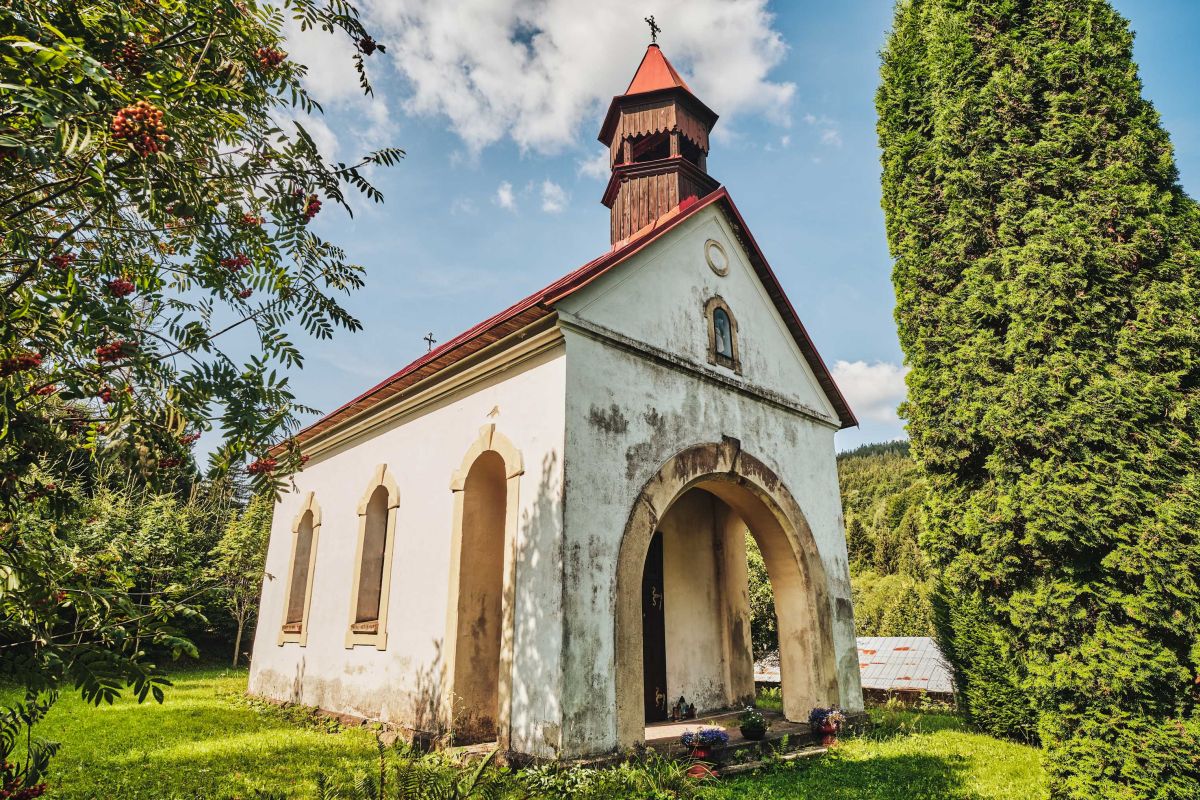
Description: On the right side of the altar, there is a painting of the Visitation on the wall of the apse, and on the left side, a painting of the Pietà (of Our Lady of Sorrows). The chapel is well-lit by four semicircular windows – two on each side of the nave. The upper semicircular part of the windows is colored – purple-blue-purple. Above the entrance, there is a smaller choir that spans the entire width and is accessed from the inside by a wooden staircase. The choir has an artistically wrought railing at the front with both wooden upper and lower parts. On the choir is the original smaller historic organ. According to a preserved company plaque, it was made by the organ company Teofil Kotykiewicz Harmoniumfabrik from Vienna.
The interior of the chapel is very tastefully painted. The painting features a lower burgundy-ochre accent paint on the lower wall. The nave is painted to resemble toned ochre-brown bricks, and the apse has a cylindrical pattern of a white cross on an old pink background. The apse is separated from the nave by a triumphal arch, which is only suggested by painting. It consists of two brick-brown thick bands, with yellow-brown background in between, on which various floral motifs, a golden chalice with a host, and a cross are painted. The ceiling has a sky blue color framed by a thicker yellow-brown edge with ornaments, on the blue background are painted golden stars. In the nave, the ceiling is painted similarly, with the central part forming a blue starry sky in the middle with the golden monogram of Jesus, JHS. From the letter H at the top, a Latin cross with a four-leaf clover design grows, with three nails at the bottom. This section is framed with ochre trim. In the four corners are the faces of angels with floral motifs, and the entire section has an outer border adorned with ornaments.
Above the choir on the ceiling, a gray anchor crossed with a brown cross is depicted (symbolizing faith and hope), tied with a white ribbon. The painting and individual murals are relatively well preserved, with the most damage to the accent paint on the lower wall, and moisture also affects the painting of the triumphal arch. In the back part of the apse, larger cracks are visible, with smaller (thinner) ones also present on the ceiling.
In the nave of the church, on opposite walls, there are two paintings: to the left of the entrance is the Resurrected Christ, and to the right, Christ is depicted ascending into heaven. Along both sides of the nave, next to the walls, are two wooden (likely original) benches, painted dark brown with carved sides. To the right of the door, the wall is angled to create a small space where a holy water font is installed.
The floor is made of burgundy-red and cream square tiles. The entrance consists of dark brown double doors with decorative hinge parts. The upper part of the doors is adorned with a circle in each section, in which a rosette is set. Above the frame of the doors is a wooden Neo-Gothic structure consisting of three pointed arches, with crosses between them. Behind this glazed structure is a painting depicting St. Joseph, St. Veronica, and the Guardian Angel in the center.
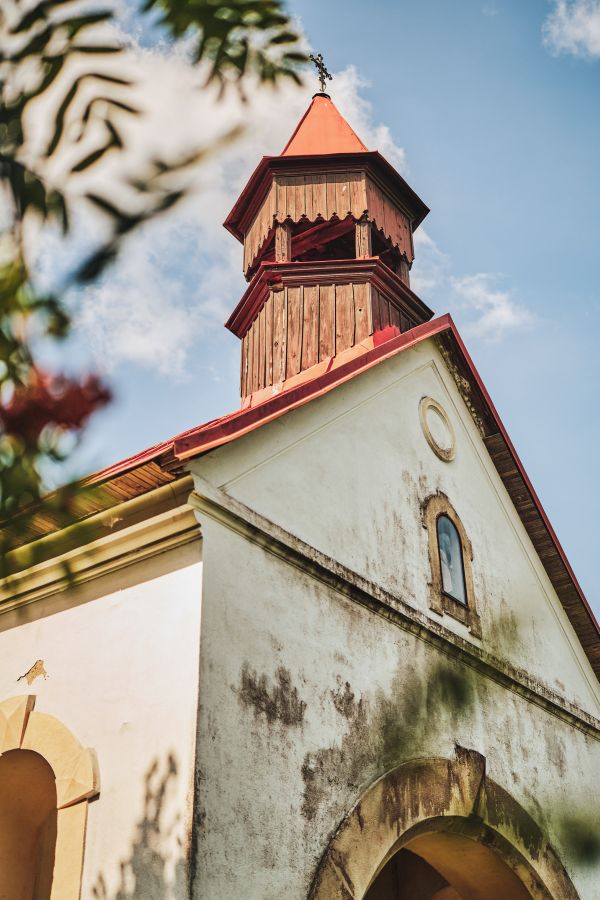
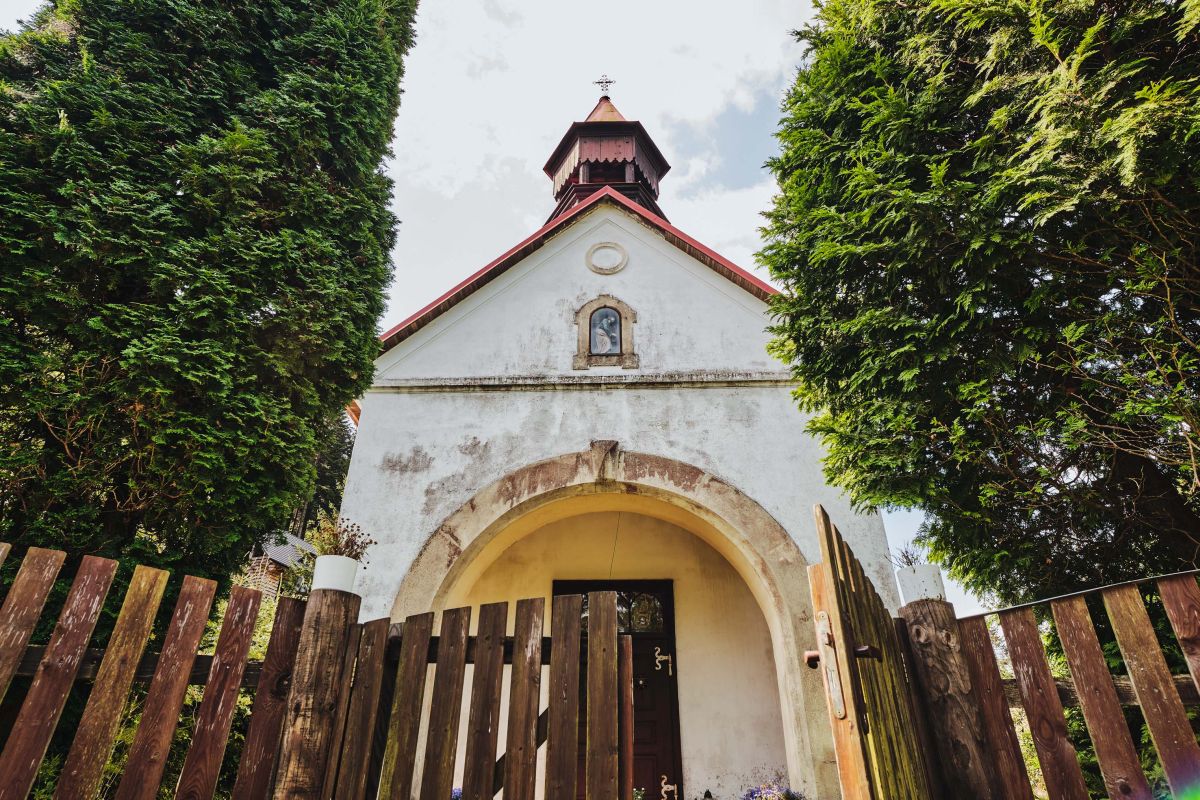
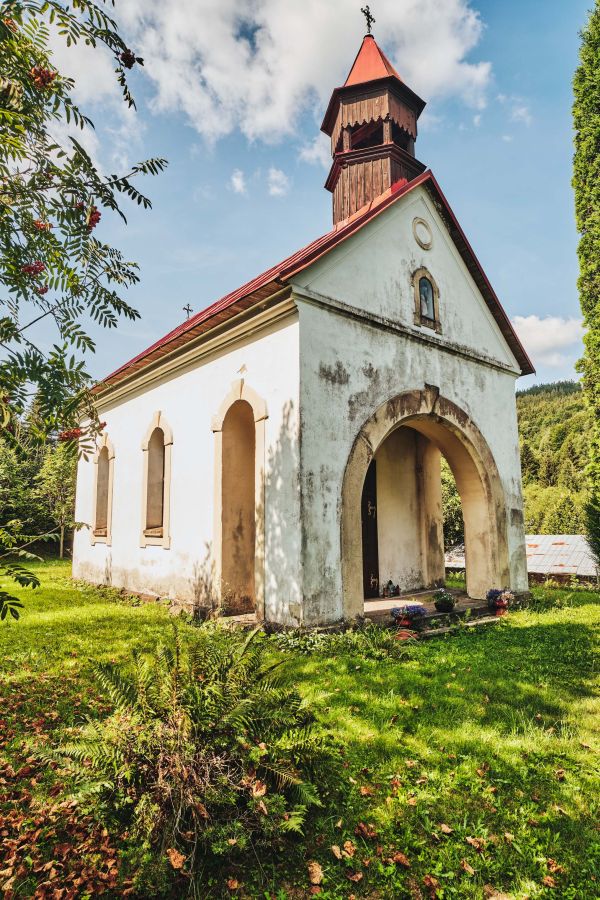
Above the entrance, the chapel has a small semi-circular niche from the outside, in which a statue of Christ carrying the cross is placed. The chapel has a white facade with yellow trims around the windows, arches, and the niche. It is covered with red metal roofing, as is the pyramidal roof of the turret, which has a small metal cross. A similar cross is also found on the roof above the apse. The outside of the turret is clad with wood on the lower part, while the upper part is only partially clad, approximately halfway, to allow the sound of the bell to resonate through the created opening.
The Bell: Dimensions were not measured due to difficult access to the bell, which is located in the small turret above the entrance to the chapel. The turret is accessed from the choir by climbing a ladder to the attic and then another ladder to a small opening in the roof. The opening must be unlocked before any further access to the bell, where space is so limited that any handling is very difficult for an adult. The bell is dedicated to Our Lady of Lourdes. It is suspended on a flat steel beam head on a circular crown. The upper and lower parts of the bell's body and rim are adorned with decorative motifs. On the body, there is a relief of Our Lady of Lourdes, the bell foundry’s emblem, and a dedicatory inscription. The bell comes from the bell foundry of Peter Hilzer in Wiener Neustadt. According to the inscription, it was cast in 1893. The company emblem reads: "PETER HILZER // K.u.K. HOF=GLOCKEN=GIESSER // IN WR: // NEUSTADT 1893." The dedicatory inscription reads: " KE CTI A SLAVE PREBL: // AHOSLAVENEJ MARIJI LOURDSKEJ // JOSEF KRUTOŠIK ZIMULIK // 1893." (In honor and glory of the Most Blessed Virgin Mary of Lourdes// Josef Krutošik Zimulik // 1893).
Surroundings: The chapel is situated in the settlement of Jedľovník, oriented northeast-southwest (entrance – apse). It is fenced on the front and left side with a small wooden fence that has a gate in the front. In addition, on three sides, there are coniferous and smaller deciduous trees planted near the fence, forming a dense cover. On the western side, the chapel is fenced off by a wire fence, separating it from some smaller farm buildings. A road runs in front of the chapel, leading further east into the settlement of Jedľovník.
Masses or worships (for which feast, regularly/irregularly): When the chapel was built, J. Krutošík established a foundation for three masses – one for the founder, one for his wife Veronika, and the third on the day of consecration. Annually, masses were to be held on St. Joseph's Day and St. Veronica's Day. Currently, mass is held once a year – in May.
Other information: It is said that Jozef Krutošík had the chapel built as a token of gratitude for his wife's recovery. He made a vow to Our Lady of Lourdes that if his wife recovered, he would have a chapel built.
Literature: VELIČKA, Drahomír. Dejiny farnosti do roku 1918 (History of the Parish until 1918). In Vysoká nad Kysucou. Vysoká n. K.: Obec Vysoká n. K., 2014, p. 92.
Text Author: Mgr. Drahomír Velička, PhD.
Photos: Štefan Strýček
Map:
Photo Gallery: